Playing For Keeps

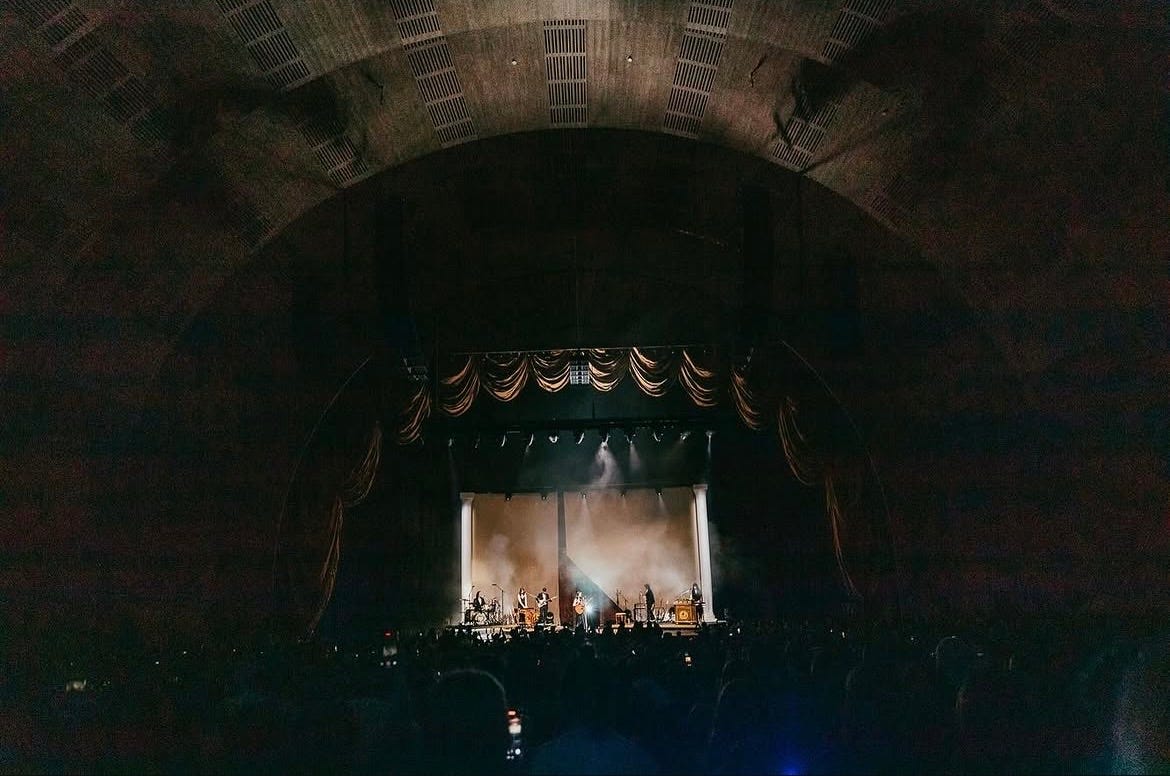
I am standing next to my girlfriend in the orchestra section of Radio City Music Hall. The lights have just dimmed. A collection of wistful strings starts playing from the loudspeakers. Lucy Dacus walks out, clad in black lace and satin, her silhouette framed by artificial fog and a spotlight shining from the back of the stage. My girlfriend and I turn to look at each other, both beaming with childlike excitement. I put my arm around them as we clear our throats in anticipation.
The second song on the set list is “Ankles,” the lead single from Dacus’ latest album, “Forever is a Feeling.” Pull me by the ankles to the edge of the bed, and take me like you do in your dreams//I’m not gonna stop you, I’m not gonna stop you this time, baby. It comes as no surprise to me that I start to tear up. For a long time, I couldn’t listen to the song without crying. I believed my emotional reaction was a product of the overwhelming love I felt for my girlfriend, a love that had grown despite the difficulties I faced in opening up, despite the many times I had stopped them.
When “Forever is a Feeling” first came out, the songs felt like an uncanny echo of my inner monologue. For the first time, I was in a relationship that lasted longer than 6 months. After a lifetime of failed infatuations, I believed I had finally found the person I would love for years to come. This imagined longevity was overshadowed by the plans I had to leave the city we shared, a city I knew they wanted to stay in. For months, we tiptoed around this crack in the foundation of our relationship.
On “Forever is a Feeling,” Dacus sings about love and with an ever-present uncertainty toward the future. In interviews, she says she was inspired to write the album when she realized how many love songs are based on fear of a relationship ending. She sought to embrace the temporality of love as she celebrated it. To Dacus, forever is not a period of time, but a feeling. And like all feelings, it is fleeting. This is bliss. This is hell. Forever is a feeling and I know it well.
In some songs, Dacus memorializes a great love in its prime. In others, she laments its seemingly predetermined end. Many commentators wrote about the album as describing two relationships, one that had to end for the other to begin. I always thought of it as a single story of a love that was no less meaningful for its narrator’s preoccupation with ephemerality. In Dacus’ lyricism, I found music that spoke to the bad feeling I could not seem to shake: that no matter how much I loved my girlfriend, no matter how much I longed for a future with them, our relationship would one day end. Not in the way that all loves eventually meet a mortal end, but sooner, in the way that some people just aren’t right for each other. I found comfort in the idea that my bad feeling did not make this end inevitable.
For years, I have labored to deal with my anxieties head-on. Instead of pushing away the thought of bad things happening, I imagine negative events in detail, followed by their outcome, to prove to myself that in every scenario, I will ultimately be okay. Not everyone responds well to this line of thinking. When my girlfriend vented their fears and insecurities, I couldn’t exactly tell them I had imagined a future where our relationship lasted for decades and one where it didn’t and come to terms with both.
Every time “Forever is a Feeling” came up in our conversations, I told my girlfriend with a naive honesty that I was fascinated by the album’s focus on the transience of love. Over time, it became clear that my comments were leading them to certain conclusions. They began to assume that I did not share their dreams for our future. As we waited for Dacus to take the stage, my girlfriend told me, “The way you interpret this album makes me sad.” I gave a resigned non-response, “Yeah.” They rushed to clarify, “Sorry, I didn’t mean that as, like, a loaded comment.” I nodded. “Sure.”
Halfway through the concert, I hear the opening lines to “Best Guess,” the song on “Forever is a Feeling” that speaks most directly to an imagined future. A couple weeks ago, my girlfriend quietly added it to the joint playlist we used to share songs that made us think of each other. You are my best guess at the future//If I were a gambling man, and I am, you’d be my best bet. The first time I heard it, I imagined the ease with which my girlfriend and I might eventually live in stable domesticity. I told myself that if I stuck it out, my apprehension would one day be replaced with certainty.
Halfway through the song, I look over at my girlfriend and see them desperately wiping away tears. I feel guilty at my wish that this were not happening. When the song ends, I put my hand on their shoulder. They recoil, angrily remarking, “You could have done that during the song.” My concern hardens at the revulsion I see on their face. I pull my hand away and look back at the stage. They collect their things and climb over several audience members to rush toward the exit.
Moments later, Dacus sits down on a lavishly upholstered couch and pulls an acoustic guitar into her lap. With a characteristic religious allusion, she croons about her partner doing the Lord’s work every time they smile at her. Then, in the song’s last few lines, her tone shifts. But I still miss you when I’m with you//’Cause I know we’re not playing for keeps. As the final chord rings out, the audience erupts with applause. I am standing alone in a crowd of screaming fans and trying to steady my breathing while I sob. My head spins, orbiting around a single thought. This shouldn’t be happening. One day, I will think of this moment as the beginning of the end.
Eventually, I won’t be able to listen to the album, but I will become obsessed with listening to Dacus talk about it. I’ll be searching for answers. Was it my very preoccupation with temporality that doomed my relationship to end? Would everything be different if I had only been more certain? In one interview, Dacus will comment on the outro of “Limerence.” I want what we have, a beautiful life//But the stillness, the stillness, might eat me alive. She will say, “I know the line makes it sound like stillness is the problem, and at the time I thought that was true, but actually it was the stillness informing me that something was wrong, and now, when I’m still, I feel at peace.”
I will realize that my obsession with the end of my relationship was not an attempt to make peace with uncertainty. There was no peace to be found. It was not a coping mechanism for an illogical anxiety, but a way of preparing myself for what I knew to be inevitable. I wasn’t uncertain at all. Deep down, I knew I would leave. I knew they would stay. I knew our love would not survive it. I did everything I could to rationalize my way out of this unbearable truth. It wasn’t enough. Sometimes, I will learn, to love someone is to be plagued by the knowledge that you will one day break their heart.
Eventually, my girlfriend comes back. Dacus is singing about spending a lifetime trying to make her lover happy and I am crying in a velvet chair with my face in my hands while my girlfriend rubs my back. After a few songs, they stand up and I rise to put my arm around them. When Dacus ends her set with her biggest hit and only angry breakup song, we move apart to jump up and down and scream along. As we leave the theater, we talk about how we will get home. We hold hands and ride the subway in silence. I push away the conclusions I’ve started to come to. I let myself believe this might be what saves us.